The cd4backcalc package for R implements Bayesian, discrete-time, multi-state models to estimate HIV incidence and undiagnosed HIV prevalence from diagnosis data.
Description
CD4 back-calculation uses a discrete-time, multi-state Markov model to represent HIV progression until diagnosis. The undiagnosed (latent) states represent decreasing CD4 strata and, when RITA evidence is used, recent HIV acquisition. Model variants can additionally stratify the population by age and country of birth. An illustration of the latent and diagnosed states in a CD4-staged back-calculation model is shown below.
Models are fitted within a Bayesian framework using cmdstanr to estimate HIV incidence, undiagnosed HIV prevalence, and diagnosis probabilities by CD4 state over time.
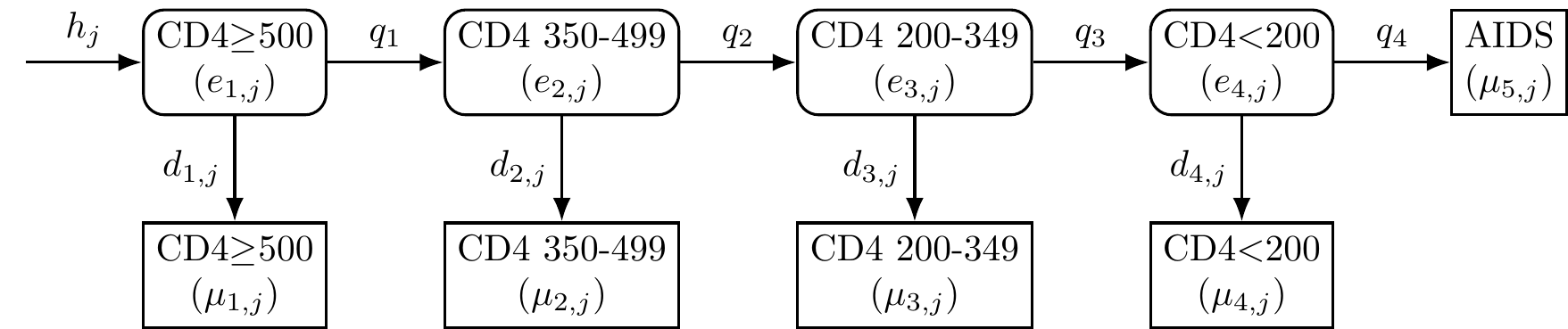
Figure: CD4-staged back-calculation model. The model compartments represent undiagnosed HIV (round boxes) and diagnosed HIV or AIDS (square boxes); the arrow represents HIV acquired at each time point (); HIV progression probabilities () vary by CD4 stratum; HIV diagnosis probabilities () vary by CD4 stratum and time.
Installation
Before installation you will need to set up a Personal Access Token (PAT) in Github with “Contents” and “Metadata” permissions for this repository. See here for instructions.
You can then install the development version of cd4backcalc with:
# install.packages(c("pak", "gitcreds"))
gitcreds::gitcreds_set() # set your PAT in the prompt
pak::pak("pkirwan/cd4backcalc")
System requirements for installation
The cd4backcalc package requires the R package cmdstanr (not available on CRAN) and the command-line interface to Stan, CmdStan. See instructions at: Getting started with CmdStanR.
- Windows users will additionally require Rtools to compile the Stan models, see: https://cran.r-project.org/bin/windows/Rtools/.
- MacOS users will require the correct GNU Fortran compiler, see: https://mac.r-project.org/tools/.
Usage
A basic workflow to simulate diagnosis data and fit the CD4-staged back-calculation model, check convergence and goodness of fit to the simulated data, and plot model estimates is shown in the example below.
library(cd4backcalc)

# simulate data under an increasing incidence scenario
sim_diags <- simulate_diagnoses(h_pattern = "increasing")

# visualise simulated data
plot_simulations(sim_diags, quantity = "incidence")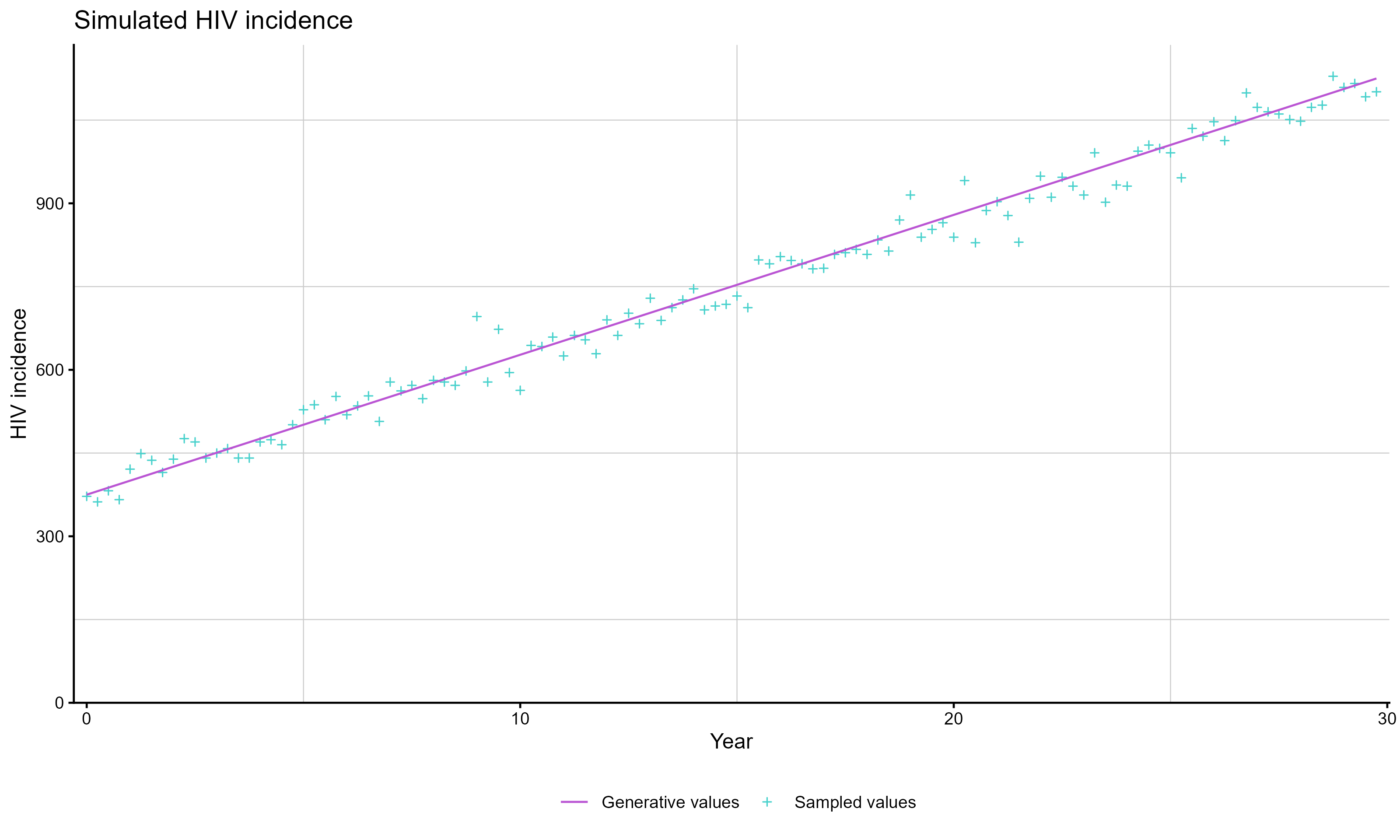
# run back-calculation model on simulated data
# default is 1000 warmup iterations, 1000 sampling iterations, and 4 chains
model_1 <- run_backcalc(sim_diags)

# check convergence
plot_diagnostics(model_1)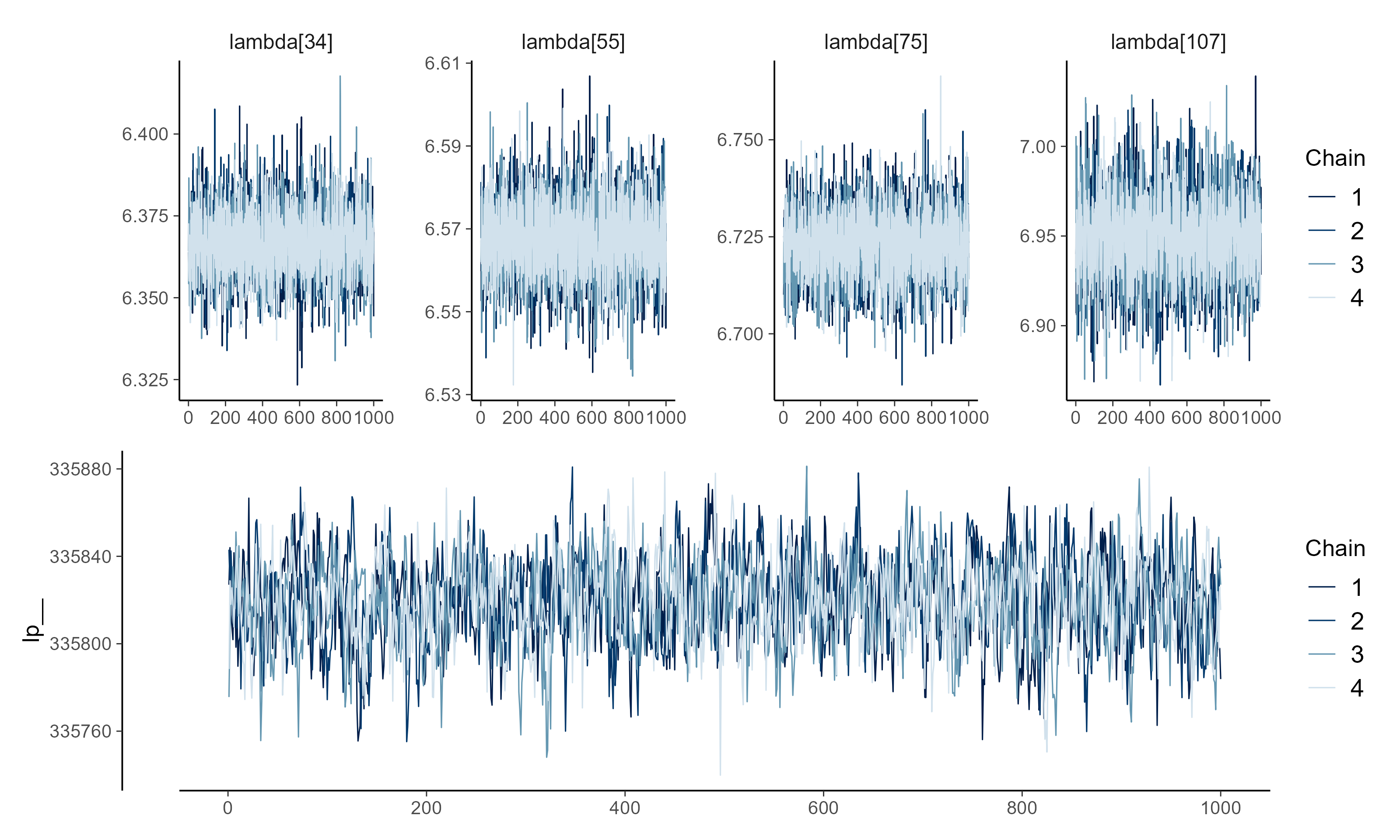
# check goodness of fit to simulated values
bias_plot(model_1, quantity = "incidence")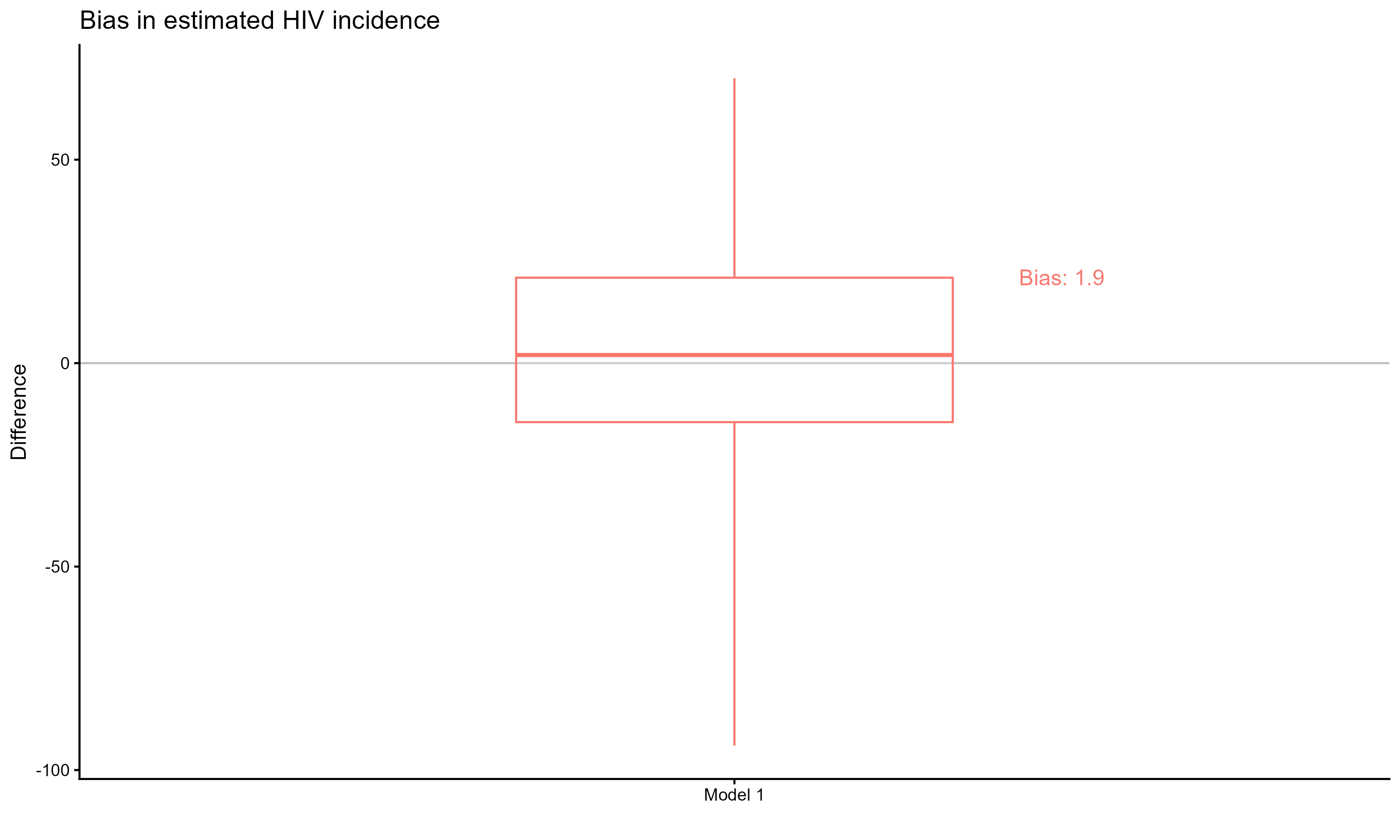
# plot estimates compared to simulated values
plot_estimates(model_1, quantity = "incidence")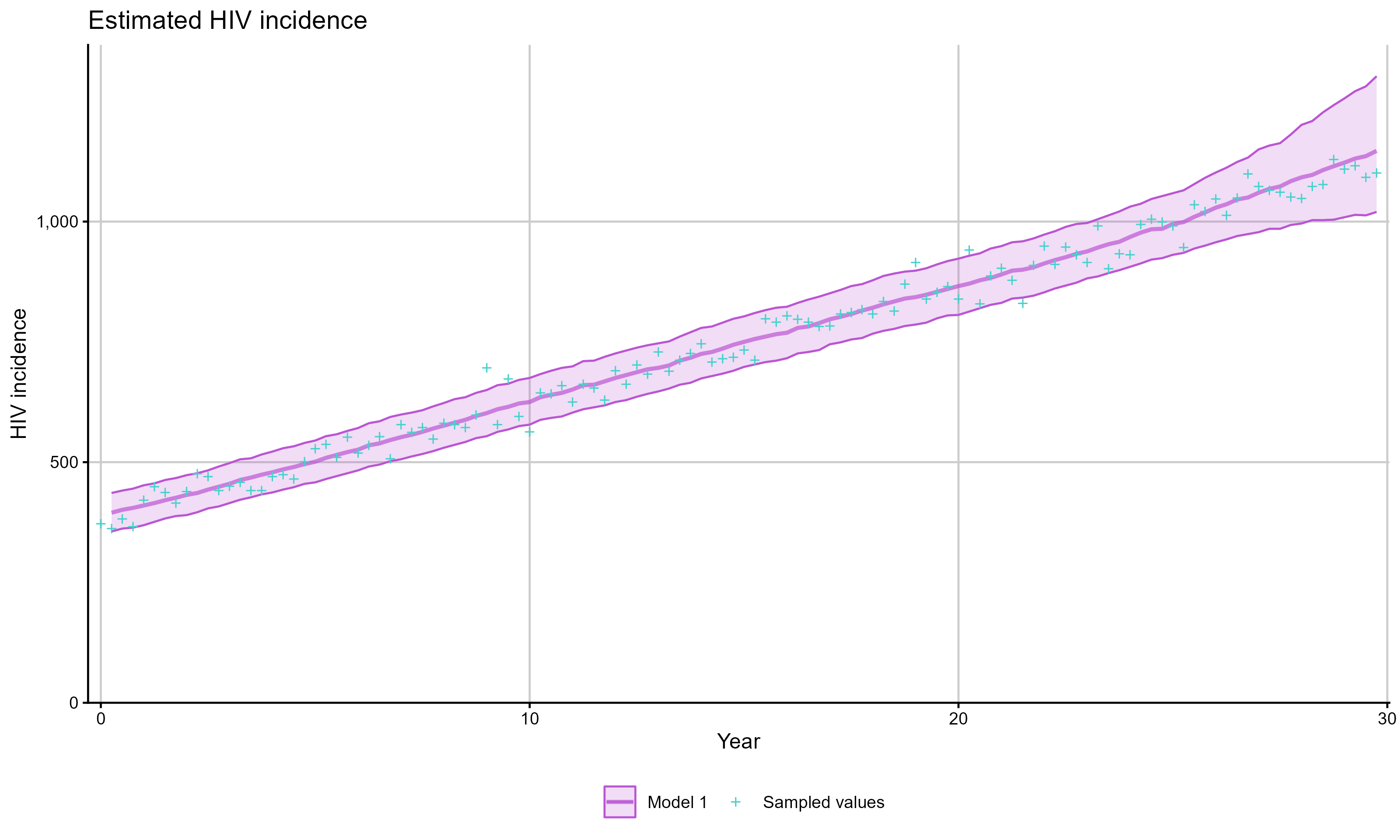
For real data, pass a Stan-ready list directly to run_backcalc() and supply the matching migration, rita, and age flags for the chosen model. The input list should contain the diagnosis arrays required for that model family:
hiv_list <- run_backcalc(
    real_stan_data,
    migration = TRUE,
    rita = FALSE,
    age = FALSE
)
Migration models can incorporate external evidence for the born-abroad to UK-born UK-acquired incidence ratio (eta_sd), detection probability (detect_obs_sd), and migration trend (gamma_obs_sd).
If plot_diagnostics() or model_1$fit$cmdstan_diagnose() indicates divergent transitions or maximum treedepth warnings, refit with a larger adapt_delta and max_treedepth.
Supported models
The cd4backcalc package includes several models, written in Stan, which can be used to fit the back-calculation model to real or simulated diagnosis data under different scenarios:
- Age-independent or age-dependent
- CD4-only or CD4 + RITA data
- With or without migration
The functions in the package are designed to work with all model variants, with the appropriate model selected based on user-specified options. The table below shows the options which should be used for each combination of RITA evidence, migration status, and age structure.
| Model | Age-independent | Age-dependent |
|---|---|---|
| CD4 | rita = FALSE, migration = FALSE, age = FALSE | rita = FALSE, migration = FALSE, age = TRUE |
| CD4 + RITA | rita = TRUE, migration = FALSE, age = FALSE | rita = TRUE, migration = FALSE, age = TRUE |
| CD4 + Migration | rita = FALSE, migration = TRUE, age = FALSE | rita = FALSE, migration = TRUE, age = TRUE |
| CD4 + RITA + Migration | rita = TRUE, migration = TRUE, age = FALSE | rita = TRUE, migration = TRUE, age = TRUE |
For the age-independent CD4-only model, run_backcalc() also supports alternative smoothing families via inf_model and diag_model.
N.B. Due to the increased complexity, fitting times can be substantially longer when using the age-dependent models. On resource-constrained systems, “checkpointing” is available to fit these models in stages, saving and reloading intermediate results, see Checkpointing and long runs for details.
Further resources
See Getting started for the basic workflow, Model types for RITA, migration, and age-dependent models, and Analysing results for extracting estimates and comparing fitted models.